
The Two Area Codes Serving Idaho
Idaho's numbering plan holds exactly two codes. The first is 208, one of the original area codes handed out across North America in 1947. The second is 986, added as a statewide overlay after regulators saw 208 running out of numbers. Existing customers kept 208. New lines can draw from either code, in any town. So a rancher near Salmon, a student in Moscow, and a state office in Boise can all hold a 986 number, or a 208 one.
There was never a split, which is the part that surprises people. No boundary was drawn, no region was handed a new code, and no customer had to reprint a business card. The cost showed up somewhere else: local dialing went from seven digits to ten.
| Area Code | Coverage | Year Assigned | Overlay Status |
|---|---|---|---|
| 208 | All of Idaho, every city, county, and rate center | 1947 | Primary, original NANP assignment |
| 986 | All of Idaho, identical footprint to 208 | 2015, in service from late 2016 | Statewide overlay |
Idaho Area Code Coverage by Region
Because the overlay is statewide, there is no coverage map to memorize. Boise, Meridian, Nampa, and Caldwell in the Treasure Valley share both codes. So do Coeur d'Alene and Post Falls in the Panhandle, Idaho Falls and Rexburg in the east, Pocatello in the southeast, Twin Falls in the Magic Valley, and Lewiston and Moscow along the rivers in the north-central part of the state. Resort towns like McCall, Sandpoint, and Ketchum sit in the same pool. Every ZIP code in Idaho can hold numbers from both 208 and 986.
Two things an Idaho area code will never tell you: the caller's city, and the caller's clock. Idaho splits between Mountain Time in the south and east and Pacific Time in the north, and the codes ignore that line completely. A 986 number in Sandpoint runs an hour behind a 986 number in Idaho Falls. When location matters, the prefix, meaning the middle three digits of the number, is the better clue.
Note: Treat an area code as proof of state at most, since portability and spoofing mean even the Idaho part is not guaranteed for an incoming call.
Idaho Cities and Their Area Codes
People still ask which code belongs to which city, usually because most states work that way. In Idaho the answer repeats down the whole list. What changes city to city is not the code but the mix: older communities and government centers skew heavily toward 208 because their numbers predate the overlay, while fast-growing areas see more 986 lines simply because growth means new numbers.
| City / Region | Area Codes | What to Know |
|---|---|---|
| Boise, Meridian, Nampa, Caldwell | 208 and 986 | Treasure Valley; state agencies keep long-held 208 lines |
| Coeur d'Alene, Post Falls, Sandpoint | 208 and 986 | Panhandle shares the overlay; no separate northern code |
| Idaho Falls, Rexburg, Rigby | 208 and 986 | Eastern Idaho, Mountain Time |
| Pocatello, Blackfoot | 208 and 986 | Southeast Idaho |
| Twin Falls, Burley, Ketchum | 208 and 986 | Magic Valley and Wood River Valley |
| Lewiston, Moscow | 208 and 986 | North-central Idaho, Pacific Time |
The practical upshot runs in one direction only. Seeing 208 or 986 tells you a number was issued somewhere in Idaho. It cannot tell you the number belongs to Boise rather than Bonners Ferry, and it cannot tell you the line still lives in Idaho at all, since mobile numbers travel with their owners.
Why Idaho Chose an Overlay
When a code fills up, regulators pick between two forms of relief. A split hands part of the map to a brand-new code, preserving seven-digit dialing at the price of forcing thousands of customers to renumber. An overlay stacks a new code on the same territory, which saves every existing number but requires full ten-digit dialing so the network can tell identical prefixes apart. The Idaho Public Utilities Commission weighed both and picked the overlay, reasoning that a split would have punished whichever half of Idaho drew the new code.
- Overlay
- A second code over the same geography. Numbers stay put. Every local call needs ten digits.
- Split
- A boundary gets drawn, and customers on one side of it renumber to a fresh code.
- Permissive Dialing
- The stretch when seven-digit and ten-digit calls both still go through.
- Number Pooling
- Sharing prefix blocks among carriers in thousand-number chunks to stretch a code's life.
Dialing Rule for Idaho Numbers
The rule is short: ten digits for every local call, everywhere in Idaho. Permissive dialing opened in late 2016, when seven-digit calls still worked while people adjusted. The grace period ended the following summer.
Important: Mandatory 10-digit dialing took effect statewide on August 5, 2017. Seven-digit local calls have not connected in Idaho since that date.
Long-distance and toll calls may still need a leading 1, carrier and plan depending. Mobile phones mostly hide the change, since saved contacts already carry area codes. The rule bites hardest on older habits: alarm systems, fax machines, and anyone reciting a number aloud the way Idahoans did for seventy years. Everything else Idahoans dial, meaning the N11 shortcuts, the star codes, and the 011 exit code, is collected under Idaho phone codes.
How Idaho's Area Codes Got Here
For a long stretch, nothing happened, and that was the story. Idaho held onto a single area code for roughly seventy years while phones multiplied. Fax lines, pagers, cell phones, and internet lines all pulled from the same 208 pool. Regulators bought time with conservation before finally adding a code, and the sequence is easy to follow year by year.
| Year | Event |
|---|---|
| 1947 | 208 assigned to Idaho in the original North American numbering rollout |
| 2002 | Number pooling begins in Boise to delay 208 exhaust |
| 2007 | Pooling expands statewide to conserve remaining 208 blocks |
| 2015 | Idaho PUC approves statewide overlay relief; NANPA assigns 986 |
| 2016 | 986 implementation begins with permissive 10-digit dialing |
| 2017 | Mandatory 10-digit dialing takes effect on August 5 |
The approval came through Case No. GNR-T-15-06, Order No. 33414, and the commission's press release from that case still reads as the plainest explanation of why Idaho dials the way it does. Pooling deserves the credit for the long delay. Instead of handing each carrier a full ten-thousand-number prefix block, pooling parceled numbers out in thousand-number chunks, so Boise carriers stopped sitting on unused inventory. The trick bought Idaho more than a decade before 986 became unavoidable.
Prefixes: The Local Layer Under Idaho Area Codes
With both area codes statewide, the prefix does the geographic work. Boise carries the state's densest cluster, including the government-heavy 334 and 332 prefixes that front so many agency numbers. Idaho Falls numbers often start with 522 through 529. Coeur d'Alene runs prefixes like 664 through 667, Twin Falls 733 through 738, Pocatello 232 through 239, and Lewiston 743, 746, and 748. Overlay prefixes under 986 follow the same rate centers, such as 986-200 in Boise or 986-215 in Coeur d'Alene.
The Treasure Valley suburbs show how growth reshapes the prefix map. Meridian, Nampa, and Caldwell added prefix after prefix as the valley filled in, from older blocks like 466 and 467 to newer 986 assignments such as 986-201 and 986-206. Pocatello tells the opposite story: its tight 232-through-239 block looks like the old landline era, laid down when one company served one town from one switch.
These are clues, not guarantees. Portability means a line carries its prefix along when it changes carriers or service types, so an old Boise landline prefix can now ring a mobile phone anywhere. The prefix layer is unpacked further on the phone codes page, alongside the rest of the numbering machinery.
Will Idaho Need a Third Area Code?
Not any time soon, by every current signal. NANPA's 2025 annual report records no relief event for Idaho, and no relief planning is on file for the 208/986 pair. Overlays add enormous capacity, since a whole second code's worth of numbers opened up in 2016, so the two-code era should hold for years.
If exhaust ever approaches again, the process would repeat: NANPA forecasts the shortage, and the Idaho Public Utilities Commission approves the fix. The IPUC also regulates telecom service questions in the state through its telecommunications utility page, captured below.
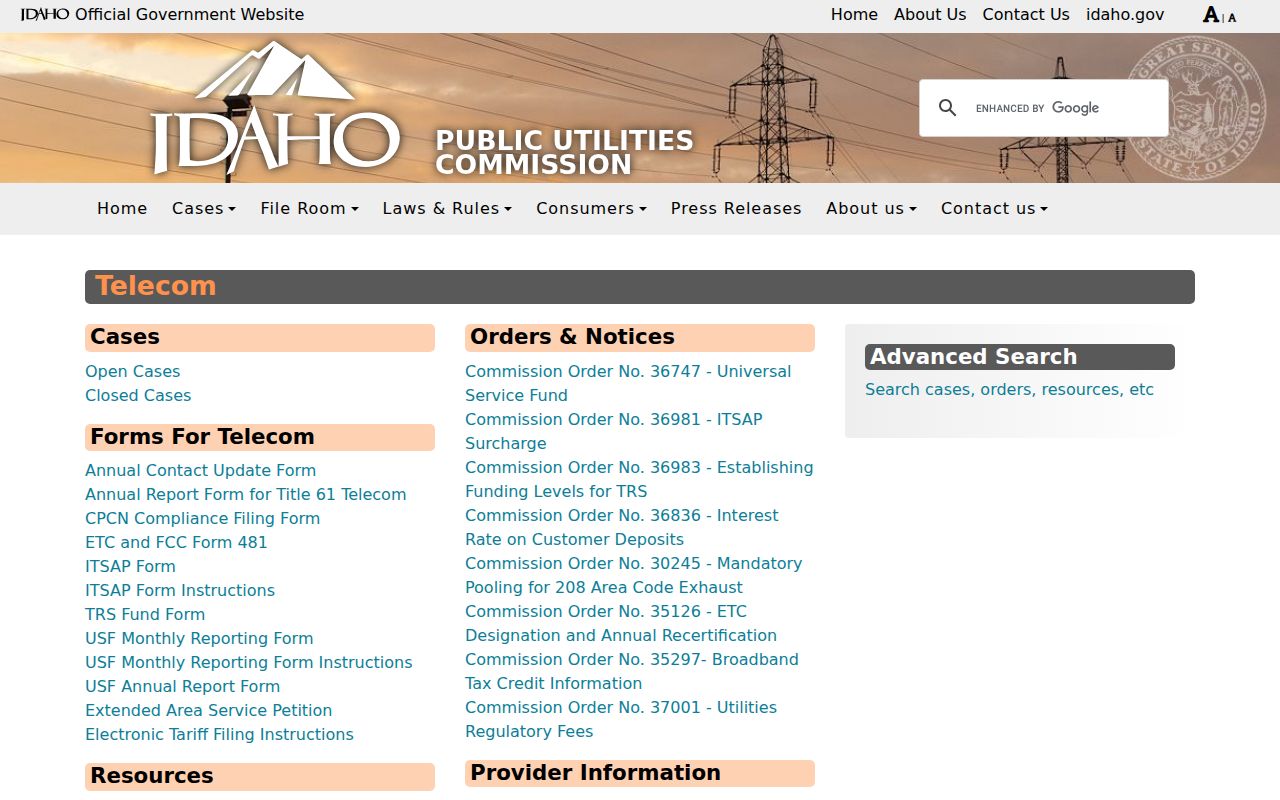
Since a future code would arrive as another overlay, residents would keep their numbers and simply see a third code appear on new lines. Ten-digit dialing is already in place, so nothing about daily dialing would change.
Verifying an Idaho Area Code
Any three-digit code claiming to be from Idaho should be one of two: 208 or 986. Anything else pretending to be an Idaho code is worth a second look. The authoritative references are the numbering administrator and the FCC, both free to check.
Note: Verifying the code only confirms it exists and belongs to Idaho, so identity checks on a specific caller still need the official directory of the office involved.